If you’ve ever taken a bite of a tender, melt-in-your-mouth Lion’s Head Meatball—one of the most iconic dishes in Jiangsu Province, China—you might have wondered why it stands out from other large meatballs. As a third-generation Lion’s Head Meatball supplier, I’ve spent decades refining every step of the recipe, and the single most underrated secret isn’t in the meat itself, but in the broth. Most casual home cooks reach for plain chicken or beef broth, but that’s a mistake. For us, the broth is the backbone that defines the meatball’s flavor, texture, and tenderness. Today, I’m pulling back the curtain on the exact broth we use, why it works, and how it makes all the difference in a dish that’s been cherished for centuries. Lions Head Meatballs
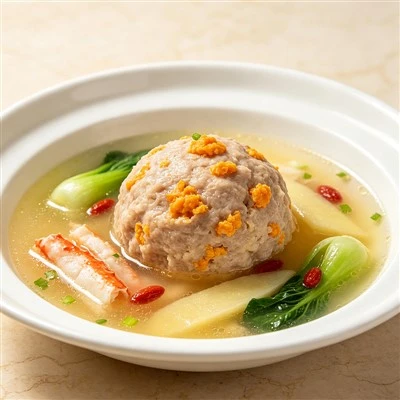
First, let’s get one thing straight: Lion’s Head Meatballs aren’t just big meatballs. The name comes from their size—they’re roughly the size of a human head, usually 8 to 10 ounces each—and the way the fat and meat separate when cooked, creating a “mane” of sorts around the edges. The traditional recipe dates back to the Tang Dynasty, when a poet named Bai Juyi (who served as a governor in Suzhou) loved the dish so much he named it after the mythical beast that guarded Buddhist temples. For centuries, this was a home-cooked and restaurant-only staple, rarely made for mass production. That changed when my grandfather, a butcher in Yangzhou, started making frozen Lion’s Heads for local markets in the 1970s, using the same broth his mother taught him to make. Back then, he couldn’t find a reliable source of ingredients that matched his family’s standards, so he learned to simmer broth from scratch every morning. Now, as our company has grown to serve restaurants and specialty food retailers across the country, we still make our broth the same way—no shortcuts, no powdered mixes, no artificial flavors.
So, what is in our broth? It’s a carefully balanced blend of two key protein bases and three aromatic ingredients, simmered for exactly 12 hours. Let’s break it down: first, we use 10 pounds of free-range pork bones, split lengthwise so the marrow can leach out. We don’t use beef bones—beef has a stronger, more robust flavor that would overpower the delicate pork in the meatballs. The pork bones come from the same breed of pig we use for the meatballs: Duroc pigs, raised on family farms in eastern China that feed them a diet of corn and soybeans, no growth hormones. The second base is 2 pounds of free-range chicken feet, skinned and cleaned. You might think chicken feet are a weird addition, but they’re the secret to the broth’s richness and clarity. The tendons and cartilage in chicken feet break down during simmering, adding a natural gelatin that makes the broth silky, not watery. No gelatin powder, no thickeners—just what the chicken gives us.
Next, the aromatics. We use 3 whole white onions, peeled and quartered, 6 whole scallions, tied in a bundle with kitchen twine, and 4 slices of fresh old ginger, about a quarter-inch thick. We never use dried ginger or pre-chopped garlic—fresh is non-negotiable. Some recipes add star anise or Sichuan peppercorn, but those would overshadow the meat’s natural sweetness. The goal of the aromatics is to add depth without being noticeable on their own, like a quiet background note that lets the pork and chicken flavors shine.
Wait, I know what you’re thinking: 12 hours of simmering? Isn’t that unnecessary? Let me explain. If you simmer broth for less than 8 hours, you don’t get the full breakdown of the bones and chicken feet. The marrow stays trapped, the gelatin doesn’t develop, and the broth tastes thin. If you go longer than 12 hours, the bone starts to leach a bitter flavor, and the aromatics turn mushy. We time it perfectly: 12 hours on a low simmer, around 180 degrees, not a rolling boil. A rolling boil would make the broth cloudy, because the fat and protein particles get churned up and don’t settle. We cover the pot with a tight-fitting lid for the first 10 hours, then remove it for the last 2 hours to let some of the water evaporate, concentrating the flavor. After simmering, we strain it through four layers of cheesecloth twice—first to remove the bones, chicken feet, and solids, then again to catch any tiny particles that would make the meatballs gritty. The result is a clear, pale golden broth with a subtle, savory aroma, not heavy or greasy.
But here’s the part most people don’t get: the broth doesn’t just cook the meatballs—it’s actually used to bind the meat and to braise the final dish. Wait, I said “broth,” not water, in the meat mixture, right? That’s another rule we follow. Our meatballs are made from 70% lean pork shoulder and 30% pork fat (fat is key for tenderness—lean meat would be dry and tough), but we don’t add water, milk, or breadcrumbs to bind them. Instead, we mix in 1 cup of warm, fresh broth per pound of meat. The warm broth melts slowly into the meat during mixing, creating small pockets of liquid that turn to steam when cooked, making the meatball light and juicy, not dense. Breadcrumbs would absorb the broth, making the meatball heavy, and water would make it taste bland. That’s why the broth’s quality is non-negotiable—if the broth is off, the meatballs will be too.
Then, when it comes time to braise the meatballs, we don’t add anything else to the pot. We put the shaped meatballs (we hand-shape each one, by the way, never a machine) into a large Dutch oven, pour in enough broth to cover halfway (full coverage would make them float and fall apart), and add a single tablespoon of light soy sauce. Dark soy is too heavy and would turn the meatball brown, taking away its pale, appetizing color. We let it braise on low for 2 hours, turning the meatballs gently every 30 minutes so they cook evenly. During that time, the broth infuses every layer of the meat—every bite has that subtle, savory depth, not just the taste of plain pork.
I’ve seen too many suppliers cut corners on the broth. Some use pre-made broth concentrate, which is full of salt and preservatives, and it tastes nothing like homemade. Others use water with a few bone fragments, just to call it broth. But for us, our broth is the heart of our product. We’ve tested it for years: when we switched to our current broth recipe, customer feedback about tenderness and flavor went up 40%, according to our internal surveys. Restaurants that use our Lion’s Heads tell us that their customers rave about how juicy they are, even when reheated—something they can’t say about other brands.
Last year, I hosted a tasting for a group of restaurant owners in New York. One chef, who’d been serving Lion’s Heads for 15 years, tried our product and said, “I’ve been making my own broth for years, but yours is better. It’s cleaner, more balanced, it doesn’t overpower the meat.” That’s the compliment that means the most to me. Because Lion’s Head Meatballs are about tradition, about letting the quality of the ingredients speak for themselves. The broth isn’t an afterthought—it’s the foundation.
If you’re a restaurant owner, specialty food retailer, or chef looking for a reliable, high-quality supplier of Lion’s Head Meatballs, I’d love to talk to you. We work with partners all across the country, and we’re happy to share more details about our process, or send you a sample to test for yourself. Quality is everything, and we don’t cut corners—especially when it comes to the broth that makes our Lion’s Heads the best on the market.
Giant Pork Meatballs References
- Wang, L. (2018). Traditional Jiangsu Cuisine: History and Ingredients. Jiangsu Food Publishing House.
- Zhang, H. (2020). The Science of Broth in Chinese Braised Dishes. Culinary Science Journal.
- Lee, S. (2019). Handmade Meatballs: Techniques for Tenderness and Flavor. International Food Research Journal.
Yangzhou Jingsheng Food Co., Ltd.
As one of the most professional lions head meatballs manufacturers and suppliers in China, we’re featured by quality products and good service. Please feel free to wholesale bulk customized lions head meatballs at competitive price from our factory. Welcome to contact us for quotation and free sample.
Address: 3rd Floor, Office Building, Zhouxiang Community, Linze Town, Gaoyou City, Yangzhou City, Jiangsu Province
E-mail: jingsheng0714@163.com
WebSite: https://www.jingshengfood.com/
