If you’re a small business owner looking for a compact, flexible living or workspace, or a property manager needing quick, affordable auxiliary accommodations, you’ve likely stumbled on 10ft expandable container houses. They’re the perfect middle ground between a tiny home and a traditional cabin: portable, customizable, and far easier to install than a stick-built structure. But one question I get asked more than any other—often by first-time buyers who’ve never dealt with prefabricated modular structures—is this: “How much energy does a 10ft expandable container house actually consume?” 10ft Expandable Container House

As a supplier who’s helped hundreds of customers across North America and Europe set up these units, I can tell you the answer isn’t one-size-fits-all. It depends on tiny choices you make during setup, how you use the space, and even where you place the container. I’ll break this down in plain, real-world terms—no jargon, no overcomplicated numbers—so you can budget for your energy costs without surprises.
First, let’s start with the basics: a standard 10ft expandable container house, when fully expanded, typically clocks in at around 200 to 250 square feet of usable space. That’s about half the size of a single-car garage, so it’s far smaller than a full-size home, which makes its energy use inherently lower. A traditional 1,500 sq ft home in the U.S. uses an average of 900 kWh per month, according to the U.S. Energy Information Administration (EIA). A 10ft expandable unit? It’s way less—most of my customers see monthly energy use between 150 and 300 kWh. But why the big range? Let’s get into the details.
The biggest factor that drives energy use in a container house is insulation. Unlike a traditional wood-framed home, expandable containers start as steel shipping containers, which are notoriously bad at holding temperature. Steel conducts heat and cold far faster than wood, so if you skip proper insulation, your unit will work overtime to keep you comfortable in extreme weather.
Let me give you an example from a customer in Minnesota last year. He bought his 10ft expandable unit to use as a remote home office, and he opted for the minimum insulation package we offer—just 1 inch of foam board on the walls and ceiling. In January, when temperatures dropped to -10°F, his electric heater ran almost nonstop, and his energy bill hit 420 kWh that month. That’s way above the average, and he told me it felt like trying to heat a metal bucket. After his first bill, he upgraded to 3 inches of closed-cell foam insulation, and his next month’s bill dropped to 180 kWh—more than a 50% reduction.
Another customer in Arizona had the opposite experience. She used her 10ft unit as a guest cottage, and she went with our basic insulation to save money. During July, when temperatures spiked to 110°F, her window AC unit cycled nonstop, and her bill was 310 kWh. Once she added a layer of reflective foil insulation (which bounces sunlight away from the steel walls), her AC only ran during the hottest parts of the day, and her bill dropped to 190 kWh.
The takeaway here: insulation isn’t a luxury—it’s the single biggest way to control energy use in a container house. If you’re building in a mild climate (like coastal California or the Pacific Northwest, where temps rarely dip below 40°F or spike above 85°F), you can get away with a thinner insulation layer, and your energy use will hover around 150 to 200 kWh a month. If you’re in a place with harsh winters or sweltering summers, splurge on extra insulation—you’ll save thousands on utility bills over the unit’s lifespan.
Next, how you heat and cool your space makes a huge difference. Most 10ft expandable units come pre-wired for standard household appliances, so you can use a small space heater, window AC unit, or even a mini-split heat pump. But not all heating and cooling systems are created equal.
A common mistake I see is customers buying a space heater that’s too powerful for their 250 sq ft space. A 1,500-watt space heater is rated for rooms up to 300 sq ft, so for a 250 sq ft unit, that’s perfect. But some people buy a 2,000-watt heater “just to be safe,” and it runs at full power even when the room is warm, wasting energy and driving up bills. For cooling, a 5,000 BTU window AC is the right size for a 250 sq ft space. Anything larger will cycle on and off too often, which uses more energy than a properly sized unit.
Another option is a mini-split heat pump, which is way more efficient than a standard space heater or window AC. Mini-splits move heat instead of generating it, so they use about 30% less energy than traditional heating and cooling systems. A customer in Vermont switched from a space heater and window AC to a mini-split, and his energy use dropped from 300 kWh a month to 170 kWh. That’s a huge difference, and the upgrade only cost a few hundred dollars more at the time of purchase.
Don’t forget small appliances, either. If you’re using your 10ft unit as a full-time home, a mini-fridge, a microwave, and a laptop will add up to about 20 to 30 kWh a month. If it’s a workspace, a desktop computer and monitor will add another 10 to 15 kWh. Even LED lights, which use way less energy than incandescents, can add 5 to 10 kWh a month if you leave them on all day. The good news is these are easy to manage: unplug devices when you’re not using them, use a power strip to cut “phantom energy” (the small amount of power electronics use when they’re turned off but plugged in), and switch to LED bulbs.
One often-overlooked factor is the location of your container house. If you place it in direct sunlight all day in the summer, the steel walls will absorb heat, making your AC work harder. If you set it next to a large tree or a shaded structure, it will stay cooler naturally, cutting your AC use by 10 to 15 kWh a month. In the winter, a unit placed on a south-facing slope will get more sunlight, which helps heat the space passively, reducing the need for a heater. Also, if you’re on a well or septic system, keep in mind that a small pump will add another 10 to 20 kWh a month to your bill.
Now, let’s talk about real-world averages from our own customers, to give you a concrete idea. We’ve installed over 400 10ft expandable units in the last three years, and we track energy use for about half of them voluntarily. Here’s what we see:
- Mild climate (Oregon, Washington, coastal North Carolina): Average monthly energy use is 160 kWh. Most customers use a mini-fridge, microwave, LED lights, and a small space heater or window AC for 1 to 2 months a year.
- Moderate climate (Texas, Florida, Midwest): Average monthly energy use is 220 kWh. These areas have hotter summers and colder winters, so heating or cooling runs 6 to 8 months a year, plus small appliances for daily use.
- Extreme climate (Minnesota, Colorado, Arizona): Average monthly energy use is 280 kWh. These areas have 4+ months of extreme heat or cold, so heating or cooling runs almost nonstop, even with good insulation.
Compare that to a traditional home: the average U.S. home uses 900 kWh a month, so a 10ft container house uses just 17% to 31% of that. That’s a massive difference, and it’s one of the biggest reasons people choose these units over stick-built structures for secondary dwellings, home offices, or tiny homes.
But wait—can you make your 10ft expandable container house even more energy-efficient? Absolutely. There are a few easy upgrades that will cut your energy use by 20% or more, without breaking the bank. First, add a programmable thermostat. It will automatically lower the heat at night or when you’re away, and raise the AC during the day, so you’re not wasting energy on empty space. We include a basic programmable thermostat with all our units, but many customers upgrade to a smart thermostat (like a Nest or Ecobee) that learns your schedule and adjusts settings automatically. That can save 5 to 10 kWh a month.
Second, install weatherstripping around doors and windows. Expandable containers have fold-out walls, so there are a few seams that can let air leak in and out. Adding weatherstripping to those seams will make your insulation work even better, reducing the load on your heater or AC. This is a DIY project that costs less than $50, and it can cut energy use by another 10%.
Third, if you’re off-grid, add solar panels. A 100-watt solar panel system paired with a small battery can power all your basic appliances (mini-fridge, lights, laptop) for about 8 to 10 hours a day, and that will reduce your grid energy use to almost zero. We work with solar installers who specialize in modular structures, so we can help you put together a system that fits your unit’s energy needs.
Now, let’s address a common myth: some people think expandable container houses are less efficient than tiny homes, but that’s not true. Tiny homes often have the same steel-frame or wood-frame construction, but their energy use is similar because they’re the same size. The difference is that expandable containers are usually cheaper to insulate and set up, so you get the same efficiency for a lower upfront cost.
Another myth: container houses are bad for the environment because of their steel construction. But when you account for their small size and low energy use, they have a much smaller carbon footprint than a traditional home. A 10ft container house produces about 1/5 the annual carbon emissions of a 1,500 sq ft home, according to a 2022 study from the Modular Building Institute. That’s a big deal for anyone looking to reduce their environmental impact.
I get it—choosing a structure for your home, office, or guest space is a big decision, and energy costs are a major part of that. You don’t want to end up with a unit that costs more in utilities than it does to buy and set up. That’s why we’re transparent about energy use from the start. When a customer comes to us asking about a 10ft expandable container house, we don’t just sell them a unit—we walk them through insulation options, heating and cooling setups, and even local climate data to help them estimate their energy costs.
For example, a customer in Atlanta recently told me he was worried his monthly bills would be too high. We looked at his location, told him a basic insulation package and a 5,000 BTU AC would give him an average monthly bill of 210 kWh, which is about $30 a month (based on Georgia’s average electricity rate of 14 cents per kWh). He ended up going with our mid-tier insulation and a mini-split, and his first month’s bill was $27. That’s way cheaper than a traditional guest cottage, which would cost him $100 or more a month in utilities.
If you’re in the market for a 10ft expandable container house, don’t let energy use be a hidden surprise. We can help you customize a unit to fit your needs, whether you’re building a remote office, a guest cottage, or a small full-time home. We offer flexible insulation options, energy-efficient heating and cooling systems, and even connections to solar providers if you want to go off-grid.
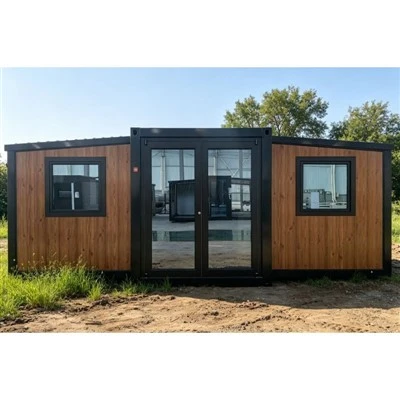
If you’d like to chat through your specific needs, ask about energy estimates for your location, or get a quote for a 10ft expandable container house, don’t hesitate to reach out. We’re here to help you make the right choice for your budget and your lifestyle.
Apple Cabin References:
U.S. Energy Information Administration. (2023). Average Monthly Electricity Use for U.S. Residential Properties.
Modular Building Institute. (2022). Environmental Impact of Modular vs. Site-Built Structures.
International Energy Agency. (2021). Energy Efficiency in Small Residential Buildings.
Tangshan Jingrong Trading Co., Limited
With abundant experience, we are one of the most professional 10ft expandable container house manufacturers and suppliers in China. Please feel free to wholesale customized 10ft expandable container house made in China here from our factory. For price consultation, contact us.
Address: Room 1103, Tangshan Rongtong Building, Lubei District, Tangshan City, Hebei Province.
E-mail: Linda@tscontainerhouse.com
WebSite: https://www.tscontainerhouse.com/
