If you’ve ever walked into a warehouse or distribution center, you’ve probably noticed the faint, grey smudges on concrete floors near forklift aisles, loading docks, or order picking zones. Those marks aren’t just a minor eyesore—they’re often from regular forklift tires leaving rubber residue, which requires frequent deep cleaning, can make floors slippery, and even lead to tripping hazards. That’s where non-marking forklift tires come in: the magic fix for those messy floors, right? Wait a second. Before you rush out to swap every tire on your fleet, there’s a big question I get asked every single day as a non-marking forklift tire supplier: do these tires fit all forklifts? Non Marking Forklift Tire
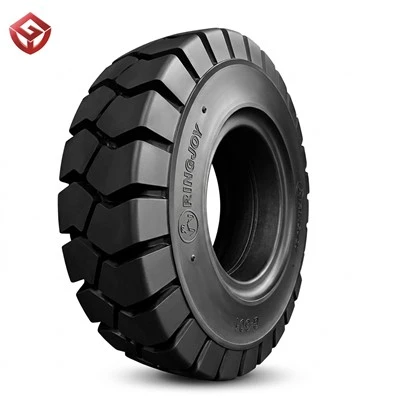
Let’s cut the jargon for a sec—this isn’t a one-size-fits-all answer. I’ve been working with forklift tires for years, talking to warehouse managers, fleet techs, and new small business owners who just bought their first used forklift. Too many folks see “non-marking” and think it’s a universal upgrade, but skip the fine print that could lead to wasted time, bad performance, or even safety issues. Let’s break it down real.
First, let’s get what non-marking tires are straight. They’re made with a special rubber compound that doesn’t leave that grey, sticky residue on concrete. Regular forklift tires are usually black, made from standard natural or synthetic rubber that’s soft enough for grip but breaks down a little over time, leaving marks. Non-marking tires, on the other hand, use a harder, pigmented rubber (usually white, light grey, or tan) that’s engineered to shed small rubber particles on smooth surfaces instead of leaving smudges. But that compound alone isn’t the only factor when it comes to fitting your specific forklift.
The first big hurdle: tire size and rim compatibility. This sounds obvious, but you’d be shocked how many people order a set of non-marking tires that look right, but don’t match their forklift’s rim size or load rating. Forklifts aren’t generic. A 3,000 lb capacity stand-up forklift used for ecommerce order picking has way different tire needs than a 15,000 lb counterbalance forklift moving steel beams at a construction supply yard. Each forklift has a specific tire size stamped on the original tire sidewall—like 6.00-9 or 7.00-12—plus a load index that tells you how much weight that tire can safely carry. Non-marking tires come in those exact sizes, but if you grab a tire that’s too small for your load, it’ll flex too much, wear out fast, and maybe even fail mid-lift. I had a customer last year who ordered non-marking tires without checking the load rating for his 8,000 lb forklift; the first time he loaded a full pallet of pallets, one rear tire blew a sidewall. He was lucky no one got hurt, but he had to fork out for replacement tires and downtime while the tech fixed it. That’s not the non-marking tire’s fault, but it’s because he didn’t match it to his forklift’s specs.
Then there’s the type of forklift you’re working with. Not all forklifts run on pneumatic tires (the big, air-filled ones) either. There’s solid pneumatic, solid cushion, and even foam-filled non-marking tires, each for a totally different use case. Let’s go through the main types:
-
Cushion tire forklifts: These are the ones with hard, solid rubber tires, usually used indoors on smooth concrete. Think of them as the workhorses for warehouses, retail stockrooms, and grocery distribution centers. Non-marking cushion tires are super common here, and they fit most standard cushion tire forklifts without issues—as long as you get the right size. But wait, if your forklift is a narrow-aisle model (those slim ones that fit between 8-foot warehouse aisles), the non-marking tires have to have a tight tolerance on the rim. Narrow-aisle forklifts have smaller tire tread widths to save space, so if you put a non-marking tire that’s too wide, it’ll rub against the forklift’s frame, cause extra wear, and even damage the side of the forklift. I work with a lot of narrow-aisle warehouse clients, so I always remind them to measure their rim width before ordering—no guesswork.
-
Pneumatic tire forklifts: These are air-filled, used mostly outdoors on uneven surfaces like gravel or asphalt. Can you get non-marking pneumatic tires? Yeah, but they’re way less common, and they don’t fit all pneumatic forklifts. Wait, why? Because the soft rubber that makes tires non-marking doesn’t hold up well to rough outdoor terrain. If you put a non-marking pneumatic tire on a forklift that runs on a construction site, the tread will chunk off way faster than a regular black pneumatic tire, and you’ll end up with more debris than you did with smudged floors. So non-marking pneumatic tires are really only for indoor forklifts that sometimes go outside briefly, like loading docks with smooth asphalt, not full-time outdoor use. That’s a big point I make to outdoor fleet managers—if you run your forklift on gravel 80% of the time, non-marking pneumatic tires aren’t worth it, and they won’t fit (or perform) for your needs.
-
Stand-up forklifts (order pickers) and pallet jacks: These small, maneuverable machines are super popular in small warehouses and retail. Non-marking tires here are a no-brainer for most models, but again—size matters. A manual pallet jack has smaller wheels than a motorized order picker, so you can’t swap order picker non-marking tires onto a manual pallet jack. I’ve had new customers try that, and it leads to wobbly operation and even damaged pallets. The key here is to check your machine’s manual for wheel dimensions and load capacity, not just the machine’s model number.
Another thing that trips people up: the working environment. Even if your tire size and forklift type line up, non-marking tires might not be the right fit if your space has unique conditions. For example, if you’re working in a cold storage warehouse (that’s 0°F or lower), the special rubber compound in non-marking tires can get too stiff, leading to cracking and reduced grip. Regular black tires are more durable in extreme cold, so non-marking won’t work there. On the flip side, if you’re in a food processing plant where cleanliness is non-negotiable, non-marking tires are a perfect fit—they don’t leave residue, so your floors stay clean and meet health codes. But if you’re in a warehouse that has a lot of heavy, sharp debris (like metal scrap), the non-marking rubber’s softer compound is more prone to punctures than regular tires. So even if it fits, it might not hold up to your daily use.
Wait, but let’s be fair—there are exceptions where non-marking tires do fit almost any forklift, right? For basic, indoor counterbalance forklifts under 5,000 lbs that run on smooth concrete? Yeah, you can pretty much swap in standard non-marking tires no problem. That’s the majority of the fleet I work with, and that’s why non-marking tires blew up in popularity—they solve the smudge problem without a ton of fuss for most small to medium warehouses. But the mistake people make is assuming that works for every forklift.
I also get asked a lot: what about compatibility with wheel alignment? If you put non-marking tires on my forklift, do I need to adjust alignment? The short answer is—no, not usually, as long as you’re buying the right size and load rating. Non-marking tires have the same outer diameter and rim specifications as standard tires, so you don’t need to tweak your alignment. But if you’re mixing non-marking and regular tires on the same forklift? That’s a bad idea, and it’ll lead to uneven wear, bad traction, and even alignment issues. So even if two tires fit your rim, you can’t mix types on one forklift.
Let me wrap this up with a quick real example. Last month, a customer who runs a small retail distribution center came to me panicking. He had 3 stand-up order pickers, and he wanted non-marking tires for them because his store’s managers were complaining about black marks on the store floors when the forklifts brought stock in. He ordered a set of non-marking tires that matched the size on his original tires, but he didn’t check the load rating—his order pickers carry up to 2,500 lbs, and the tires he ordered were only rated for 1,500 lbs. Two weeks later, one of the tires started bulging. We had to swap them out for the correct load-rated non-marking tires, and he had to pay for the return of the wrong ones. The fix? 5 minutes of checking his forklift’s manual for the exact tire specs, instead of just ordering by size. That’s the kind of avoidable mistake I see all the time.
So, to answer the big question: do non-marking forklift tires fit all forklifts? No, but they fit most forklifts when you do your homework. The key steps are: 1) Check your forklift’s original tire sidewall for size, load index, and tire type (cushion, pneumatic, etc.). 2) Match the non-marking tire to those exact specs, no guessing. 3) Consider your environment—if you’re in extreme cold, outdoor heavy use, or rough terrain, non-marking might not be the right fit for your particular setup.

If you’re not sure, that’s totally normal. I’ve been in this business for years, and I still double-check specs with customers sometimes because every forklift is a little different. If you’re looking to swap your tires and make your floors smudge-free, don’t just grab the first non-marking set you see. Reach out, share your forklift model, tire specs, and what you use your forklift for, and we can make sure you get a set that fits your machine perfectly. No guesswork, no wasted money, no headaches.
Solid Tire References
- Material Handling Industry Association. Forklift Tire Compatibility Guidelines. 2022.
- Occupational Safety and Health Administration (OSHA). Forklift Safety: Tire Selection and Maintenance. 2021.
- Rubber Manufacturers Association. Non-Marking Tire Compatibility and Performance Standards. 2023.
Zhejiang Guowei Rubber Co., Ltd.
Zhejiang Guowei Rubber Co., Ltd. is one of the most professional non marking forklift tire manufacturers and suppliers in China. With abundant experience, we warmly welcome you to buy advanced non marking forklift tire in stock here and get pricelist from our factory. Quality products and reasonable price are available.
Address: No. 10, Nanyang 4th Road, Duqiao Town, Linhai City, Taizhou, Zhejiang Province, China
E-mail: Gwsolid@gmail.com
WebSite: https://www.forkliftsolidtires.com/
