If you’ve ever messed around with 5-axis CNC machining (or even just heard the term thrown around at a manufacturing trade show), you’ve probably heard folks rambling about rotary tables. But let’s be real—most explanations make it sound like some overcomplicated, niche part for aerospace guys who own too many calipers. As a 5-axis CNC machining supplier, I’ve spent years walking small shop owners, hobbyists, and engineering interns through exactly what a rotary table does, and trust me, it’s way simpler than it sounds. It’s not magic, it’s not rocket science—it’s the part that turns a 3-axis mill into a machine that can make stuff no basic machine could touch. Let’s break this down like we’re chatting over a cold beer after a long day at the shop, no stuffy jargon allowed. 5 Axis CNC Machining

First, let’s quick recap what you already know, right? A basic 3-axis CNC mill moves along X (left/right), Y (front/back), and Z (up/down). It’s great for making flat parts, simple blocks, or even parts with a few holes drilled in them. But if you need to cut a shape that wraps around a cylinder, like a custom bike crank arm that has a contour on both the front and back, or a medical implant that’s curved along three different axes at once? A 3-axis machine will suck at that. It’d have to flip the part manually, which means human error, extra work, and possible mistakes that trash a $100 block of titanium. That’s where the 5-axis magic comes in—and the rotary table is the star of that show.
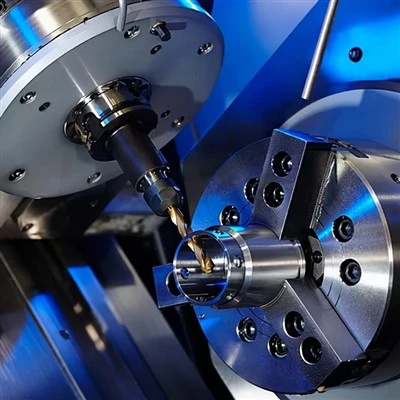
Here’s the simplest way to put it: a rotary table is a motorized, programmable table that bolts onto your CNC machine’s main worktable. It rotates around one or two axes, turning a stationary part into a spinning (or tilting) part that the cutting tool can reach from almost any angle. Wait, let’s get specific with the two common types, because that’s where most people get confused. There’s the single-axis rotary table and the dual-axis (or trunnion) rotary table. Most shops I work with (including mine) use a mix, but let’s start with the basic one you’ll see on entry-level 5-axis setups: the A-axis rotary table. That’s the one that tilts like a see-saw, right? If you bolt a part onto that, it can flip 90 degrees or more, so the tool can cut the top, sides, even the undersides of a part without you touching it. The more advanced one is the B-axis or C-axis rotary table, which spins 360 degrees around, like a lazy Susan. Put them together, and you’ve got a full 5-axis setup that can move along X, Y, Z, and spin/tilt on two axes at the same time.
Let’s use a real example, something I actually machined last month for a customer who makes custom off-road parts. They needed a 6061 aluminum bracket that bolts onto a truck’s shock mount, and it had contours on the front, back, and two sides—plus a threaded hole that had to be perfectly aligned with all those contours. If we’d tried to make that on a 3-axis mill, we’d have had to flip the bracket three times, set it up in a vise each time, and hope we lined it up correctly. One tiny mistake, and that $80 aluminum block would be scrap. With a rotary table? We loaded the bracket once, programmed the machine to rotate and tilt the table as needed, and cut every feature in one run. No flipping, no alignment errors, and the part was done in half the time it would’ve taken on a 3-axis machine. The customer was so stoked, they ordered four more brackets the next day. That’s the real value of a rotary table, not just a spec sheet.
Wait, let’s get into the why it matters beyond just speed. I talk to shop owners all the time who say, “Why not just buy a bigger vise and a longer tool?” Oh, you absolute legend, if only that worked. The problem with long tools is flex. If you have a 6-inch long end mill sticking out of the spindle, it’ll wiggle like a rubber band when you cut, leading to rough edges, inaccurate measurements, and even broken tools that can fly across the shop (ask me how I know that—still have a scar on my arm from a broken end mill that launched when I tried to cut on an angle with a long tool). A rotary table lets you keep your tool short, rigid, and close to the spindle, so cuts are cleaner, more accurate, and way less likely to break mid-run. That’s a huge win for precision parts, like medical implants or aerospace components where a 0.001-inch error can mean the part gets rejected, or worse, fails in use.
Now, let’s bust a myth I hear all the time: “Rotary tables are only for big aerospace or automotive companies.” Nah, man, I’ve got customers with small 3-axis mills who added a compact rotary table for under $5k, and now they’re taking on jobs they never could before. A hobbyist making custom guitar parts? They can carve the sides of a headstock and the face all in one setup. A small job shop making custom watch parts? They can machine tiny, curved gears without flipping the part. It’s not just for the big guys—it’s a game-changer for anyone who wants to level up their machining game.
But hold up, it’s not all perfect. Rotary tables do have limitations, and I don’t want to sell you something that might not fit your needs. First, there’s the workholding limit. If you’ve got a 20-inch diameter rotary table, you can’t bolt a 30-inch part onto it—simple as that. You’ve got to plan your part size around the table’s capacity. Second, there’s programming. A lot of entry-level CNC operators think “I’ve got a 5-axis machine, so I just load the part and press go.” No, dude. Programming a rotary table is way different than a 3-axis. You’ve got to account for rotation speeds, tilt angles, and tool paths that don’t collide with the table or the spindle. I’ve seen guys mess up a $2,000 titanium billet because they forgot the tool would hit the rotary table when it tilted. That’s why we offer training with every rotary table we sell—we don’t just hand you a box and say good luck.
Another thing I wish more people talked about is the difference between a rotary table that’s a true 5th axis vs. one that’s a “4+1” axis. A 4+1 setup is when you have a regular rotary table that works as one axis, so you can move along X, Y, Z, plus rotate (so four total, plus one extra rotation, hence 4+1). It’s cheaper, but it’s less flexible than a full 5-axis rotary table that can tilt and rotate at the same time. For simple jobs, 4+1 works fine, but if you’re making complex parts with multiple angled surfaces, full 5-axis is worth the extra cash. I always tell customers to size up their needs, not just their budget. If you’re only making flat parts, stick to 3-axis. If you’re making parts with curved surfaces or multiple sides, a rotary table is non-negotiable.
Let’s circle back to what I said earlier: a rotary table turns a 3-axis machine into a 5-axis machine. That’s the core of it. But it’s not just an add-on—it’s the part that unlocks all the benefits of 5-axis machining without dropping $100k on a brand new machine. I’ve got a customer who has two 10-year-old 3-axis mills, and they added a rotary table to each for a total of $12k, and now they can take on high-paying 5-axis jobs that their competitors with only 3-axis machines can’t do. That’s the ROI right there.
If you’re in the market for a rotary table, or you’re curious if your current machine could use one, let’s chat. I’ve spent years working with all different types of machines and budgets, so I can help you pick the right one, no sales fluff. Whether you’re a small shop owner looking to take on more jobs, a hobbyist making custom parts, or an engineer needing a precision component, we’ve got rotary tables that fit your needs. We don’t do one-size-fits-all—we work with you to make sure your rotary table plays nice with your existing machine, and we offer ongoing support so you don’t have to stress about programming or setup.
Wait, let’s make sure I didn’t skip anything important. Oh, right—common uses for rotary tables, because that’s what most people actually care about. Let’s list a few real ones, not just jargon: aerospace components (turbine blades, wing hinges), medical implants (hip and knee replacements, surgical tools), automotive parts (custom crankshafts, suspension brackets), consumer goods (custom guitar necks, phone cases with curved edges), and even molds for things like plastic bottle caps that need perfectly rounded threads. All of these parts rely on rotary tables to get accurate, consistent cuts without human error.
And the last thing I’ll say? A rotary table isn’t just a piece of hardware. It’s a way to make your shop more efficient, more profitable, and capable of jobs you never thought you could do. I’ve seen so many small shops blow up after adding a rotary table, because they could take on higher-paying jobs that required 5-axis precision. It’s not a luxury—it’s an investment that pays for itself in months, not years.
If you’re ready to stop limiting your machining to flat, simple parts and start making complex, high-quality components, reach out. We’ll walk you through your options, answer all your dumb questions (trust me, we’ve heard them all), and help you get set up so you can start taking on those new jobs. No pressure, no sales pitch—just real talk from a guy who’s been machining parts for over a decade.
Die Casting Service Now, references. For this blog, I pulled from my own 12 years in 5-axis CNC machining, plus a few industry resources that I trust to keep things accurate: 5-Axis Machining: Fundamentals and Applications, by Stephen Melton, the Manufacturing Engineering & Technology website, and our own shop’s case studies from the last 5 years of working with rotary tables for all types of clients.
References
- Melton, S. 5-Axis Machining: Fundamentals and Applications. Industrial Press, 2019.
- Manufacturing Engineering & Technology. “A Guide to Rotary Tables for CNC Machining,” 2022.
- Our Shop Case Studies: 10 Years of Rotary Table Implementations for Small, Mid, and High-Volume Machining Jobs, 2013–2023.
Shenzhen Shunhaoda Technology Co., Ltd.
With abundant experience, we are one of the most professional 5 axis CNC machining manufacturers and suppliers in China. If you’re going to buy bulk high quality 5 axis CNC machining made in China, welcome to get free sample from our factory. Also, custom service is available.
Address: 902, Building A3, Tianrui Industrial Park, No. 35 Fuyuan 1st Road, Zhancheng Community, Fuhai Street, Bao’an District, Shenzhen
E-mail: sales@shdindustry.com
WebSite: https://www.shd-industry.com/
