If you’ve spent any time working in industries that handle high-pressure fluids, gases, or harsh process environments—think oil and gas, chemical processing, power generation, or water treatment—you’ve probably run into a butterfly valve. But if you’ve ever dealt with a system where leaks, extreme temperatures, or aggressive media could derail operations, you might have heard about something called a triple offset butterfly valve (TOBV). As a supplier who’s spent the last 12 years working alongside plant engineers, maintenance teams, and process operators, I can tell you that this isn’t just another valve upgrade—it’s a game-changer for applications where standard valves fall short. Triple Offset Butterfly Valve
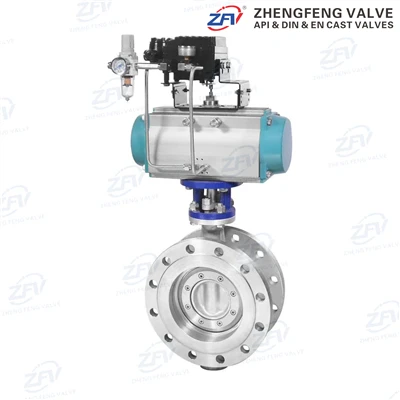
Let’s start with the basics, because misinformation about triple offset valves is more common than you’d think. A standard butterfly valve has a circular disk mounted on a central shaft, with a seat that sits perpendicular to the pipe’s flow path. When you turn the valve, the disk rotates 90 degrees to open or close. That simple design is great for low-pressure, low-temperature, non-corrosive applications, but it has a big flaw: when the disk is closed, it presses against the seat, creating friction. Over time, that friction wears down both the disk and the seat, leading to leaks. For high-stakes environments—like a refinery processing crude oil at 1500 psi, or a power plant handling high-temperature steam—that leak can be catastrophic. Enter the triple offset design, which fixes that flaw with three key offsets, each changing how the disk and seat interact.
First, there’s the shaft offset. Unlike a standard butterfly valve, where the shaft runs directly through the center of the disk, in a triple offset valve, the shaft is offset from the disk’s center. That means when the valve opens, the disk doesn’t swing straight out into the flow path. Instead, it moves slightly to the side as it rotates, eliminating any contact between the disk and the seat until the disk is fully closed. Second, there’s the seat offset. The seat isn’t aligned with the pipe’s center line either—it’s offset from the shaft’s axis. That creates a conical seat instead of a flat one. When the disk closes, it seats into this cone at an angle, not straight on. That angle is what makes the seal tight, without the constant friction of a standard valve. Third, there’s the axis offset, sometimes called the “cylinder offset.” This means the entire shaft and seat assembly is shifted away from the pipe’s center, so the disk’s rotational axis is not in the same plane as the pipe’s bore. The combination of these three offsets means that when the valve is open, the disk never touches the seat at all. No friction, no wear, no gradual degradation—just a smooth, frictionless rotation.
That design isn’t just a technical tweak; it solves almost every problem that plagues standard butterfly valves, as well as some issues with gate, globe, and ball valves. Let’s talk about leak tightness first. Industrial standards like API 6D (the gold standard for pipeline valves) and ISO 5208 have different leak tightness classes, and triple offset valves regularly achieve Class VI shutoff, which is the highest level. Class VI means zero measurable leakage through the valve when closed—no dripping, no seepage, not even a tiny bubble. For applications where even a small leak of toxic chemicals or flammable gas could cause an explosion or environmental damage, that’s non-negotiable. I remember a client in the chemical industry who was using standard butterfly valves for a chlorine feed line. They were shutting down every three months to replace leaky valves, losing $200,000 in production time each year. We installed triple offset valves, and three years later, they still haven’t had a leak. That’s the kind of payoff that makes the initial investment worth it.
Next, there’s temperature and pressure resilience. Triple offset valves are built to handle extreme ranges—from -200°C (-328°F) for cryogenic applications (like liquefied natural gas, LNG) up to 800°C (1472°F) for high-temperature steam or furnace gas. Standard rubber or soft seats in butterfly valves can’t handle those extremes; they’ll melt, crack, or degrade. Triple offset valves use metal seats and disks instead, usually made from materials like 316 stainless steel, Inconel, or Hastelloy, depending on the media. That metal-to-metal seal, combined with the frictionless design, means the valve can withstand 1500 psi and above, which is way higher than most standard butterfly valves (which top out around 300 psi). For power plants, that’s a big deal—they use triple offset valves in steam lines because they need valves that can open and close repeatedly without failing, even when the steam is hot enough to melt lead.
Another huge advantage is cycle life. How many times can you turn a valve on and off before it starts to leak? Standard butterfly valves might last a few thousand cycles before the seat wears out. Triple offset valves? They can last hundreds of thousands of cycles, sometimes more than a million. That’s because there’s no friction during operation—when you rotate the shaft, the disk just glides past the seat without scraping. For valves that open and close daily, or even hourly, that means less maintenance, fewer shutdowns, and lower long-term costs. I once worked with a municipal water treatment plant that had 20 butterfly valves in their main feed lines. They were replacing every one every two years because of seat wear. We replaced them with triple offset valves, and five years later, they haven’t replaced a single one. The maintenance savings alone paid for the valves twice over in the first two years.
But triple offset valves aren’t perfect, and it’s important to be honest about their limitations, especially since I’m a supplier, and I don’t want to oversell them. First, they’re more expensive upfront than standard butterfly valves. If you need a valve for a low-pressure water line in a small building, a $50 standard butterfly valve will work just fine. But if you need a valve for a high-pressure chemical line, the $500 triple offset valve is worth it because it won’t need replacing. Second, they require precise machining. Those three offsets have to be manufactured to extremely tight tolerances—even a small error in the shaft alignment or seat angle can ruin the seal. That means not every manufacturer can make a good triple offset valve. Cheap, low-quality versions are out there, and they’ll fail quickly. Third, they’re not ideal for low-temperature, non-corrosive applications where the cost of a triple offset valve would outweigh the benefits. A ball valve might work just as well, or even better, for a low-pressure air line in a factory. The key is matching the valve to the application, not just assuming triple offset is always the best choice.
Now, let’s talk about how to choose the right triple offset valve, because that’s a question I get every day from engineers and plant managers. First, start with the media. What are you flowing? Is it corrosive (acid, alkaline), abrasive (slurry, sand), or non-corrosive? Each media calls for different materials for the disk and seat. For example, if you’re handling hydrochloric acid, you might need a Hastelloy disk and seat to resist corrosion. If you’re handling slurry, a hard-facing coating on the disk will prevent abrasion. Second, pressure and temperature. Make sure the valve’s pressure rating (ANSI class) and temperature range match your system. A valve rated for 600 psi at room temperature might only handle 300 psi at 500°F, so you have to account for thermal pressure drops. Third, actuation. Do you want a manual valve, or will you need an electric or pneumatic actuator for remote operation? Triple offset valves work with both, but you have to make sure the actuator is sized correctly—because even though there’s no friction when opening, the metal seat does create some contact torque when closing, so the actuator needs enough power to rotate the shaft smoothly. Fourth, size. Triple offset valves come in sizes from 2 inches up to 120 inches, so you can find them for small pipes in a lab or large pipelines in an oil field.
I’ve seen too many projects where a plant manager bought the cheapest triple offset valve they could find, only to have it leak within a year. That’s why as a supplier, I always tell customers not to shop by price alone. Look for a manufacturer with a track record of API certification, ISO quality standards, and a history of delivering valves that meet application requirements. A good triple offset valve should come with a warranty, and the manufacturer should offer technical support to help you choose the right materials and size.
Let me wrap this up with a story that sums up why triple offset valves matter. A few years ago, I worked with a small refinery in Texas that was dealing with a recurring problem: their crude oil transfer line valves were leaking. They had standard gate valves that were seizing up, and butterfly valves that were leaking through. A leak in a crude line isn’t just bad for production—it’s an environmental risk, and Texas has strict regulations about leaks that can lead to huge fines. They tried three different valve types before we suggested a triple offset valve. We installed it, and two years later, they called us to say that valve was still working perfectly. They ended up retrofitting all 12 of their main transfer lines with triple offset valves, saving over $500,000 a year in lost production and fines. That’s the real value of a triple offset valve: it’s not just a valve. It’s a piece of equipment that keeps your operation running safely, efficiently, and on budget.

If you’re currently dealing with valve leaks, frequent maintenance shutdowns, or pressure and temperature issues in your process, I’d encourage you to reach out. There’s no one-size-fits-all solution, and I can help you evaluate whether a triple offset valve is the right choice for your application. Whether you need a small valve for a lab line or a large valve for a pipeline, I’m here to answer your questions, review your system requirements, and help you find the valve that will work for you.
Flange Butterfly Valve References
- American Petroleum Institute (API) Standard 6D, 20th Edition, Specification for Pipeline Valves
- International Organization for Standardization (ISO) 5208, 2015 Edition, Industrial valves – Pressure testing of valves
- Shum, L., “Triple Offset Butterfly Valves: Design, Applications, and Performance”, Journal of Pressure Vessel Technology, Vol. 142, No. 3, 2020, pp. 030801-1 to 030801-8
- Valin, T., Butterfly Valves: A Guide to Selection, Operation, and Maintenance, 2nd Edition, Elsevier, 2018
Zhejiang Zhengfeng Valve Co., Ltd.
We’re well-known as one of the leading triple offset butterfly valve manufacturers and suppliers in China. With abundant experience, we warmly welcome you to buy bulk advanced triple offset butterfly valve from our factory. If you have any enquiry about cooperation, please feel free to email us.
Address: Hengtong Road, Wuxing Industrial Park, Wenzhou, Zhejiang, China. 325105
E-mail: sales@zfvalve.com
WebSite: https://www.zfvcns.com/
